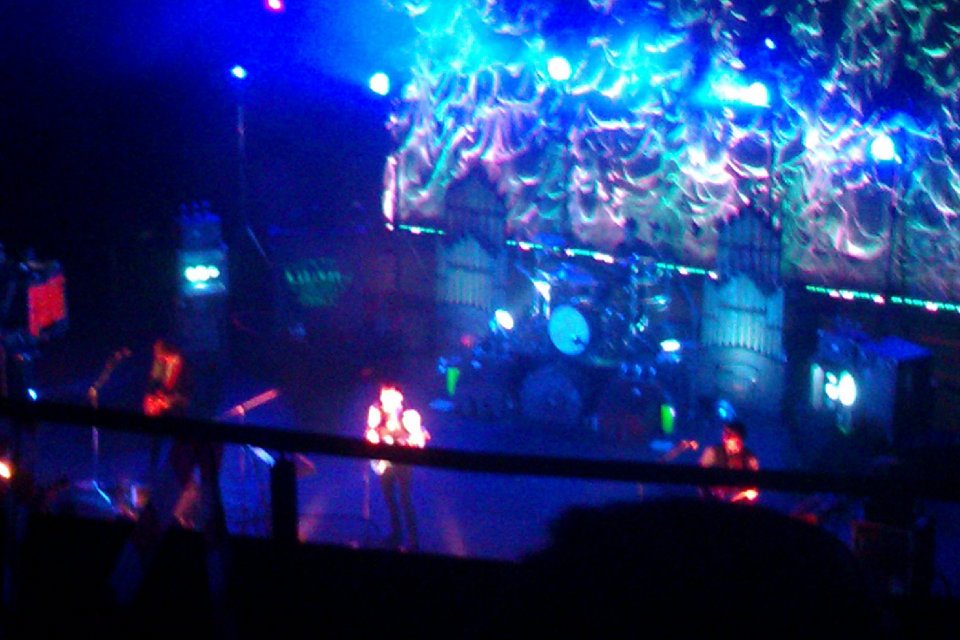
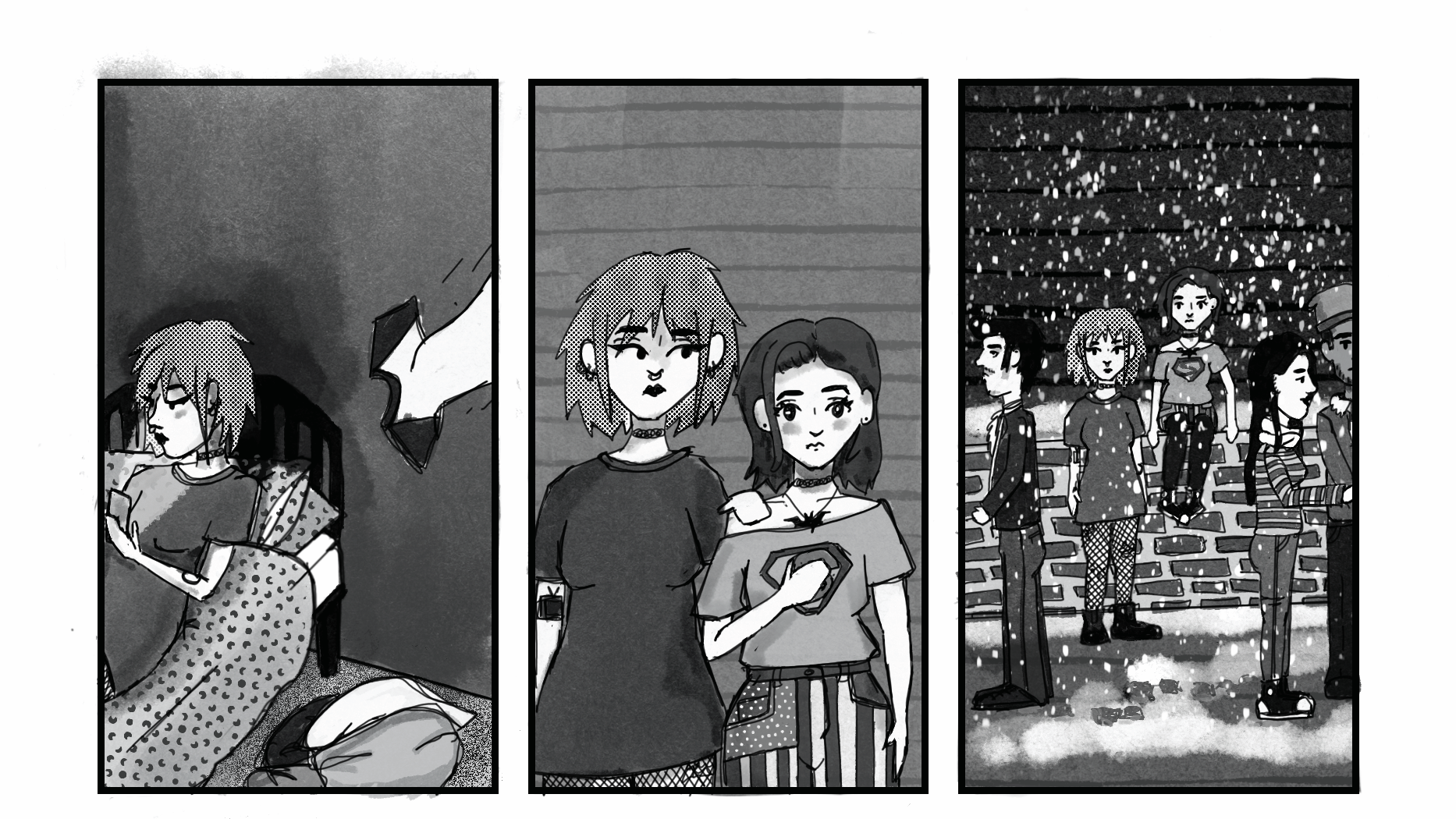
February 3rd is the anniversary of my first gig. Back in 2012, I saw Panic! At the Disco at the Brixton O2 Academy; it was a group effort to decide what to wear. We settled on my American flag shorts from Topshop and my cut-off Superman t-shirt, with tights and Converse high-tops. It began snowing as my cousin and I waited in the queue that wrapped around the block and to Stockwell Park Walk, and thus there was no hesitation in buying a hoodie from the merch stand the second I was close enough to yell my preferred size. I also found a merch necklace on the floor that someone had dropped, and I still feel a bit guilty that I just picked it up and kept it.
We had balcony seats because I was 13.
Of the gig itself, I remember fragments. I remember the support act being a band called ME – in part because they were giving away free iTunes downloads of their latest EP on all the seats. Facebook reminds me that the first support act was a group called Big Kids; and I’m not sure to which the memory of a saxophonist belongs to. The night lives on in an album on Facebook: 72 photos of the blurriest stage shots you’ve ever seen, lovingly and desperately captured on what was likely a hand-me-down iPhone 4. The photo album is titled It was always you falling for me, (now there’s always time…) a lyric from the song ‘Always’. Which was fitting; the tour was for the album Vices & Virtues which was released in 2011.
In the history of Panic! At the Disco, Vices & Virtues was the first album released after the 4-piece became a 2-piece; when Ryan Ross and Jon Walker left the band. I have no doubt many passionate blog posts, both then and to this day, have been penned to explore the reason for the split and the creative impact it had on the band. We’ll explore it together later in this one, too, but at the time I didn’t care and didn’t really know the difference. Panic! At the Disco were just Panic! At the Disco, Vices & Virtues was a seemingly organic development of their sound after Pretty Odd and A Fever You Can’t Sweat Out – and I had a crush on Brendon Urie.
The thing is, and I promise this won’t be a pattern for every post, but I can’t overstate how important Panic! At the Disco is to me. At least, to the formation of me. Whilst not the band who inspired me to write (that would be My Chemical Romance, with Danger Days: The True Lives of the Fabulous Killjoys), Panic! are the band which introduced me to comics.
I don’t think I need to expand on why that’s significant.
But with nostalgia comes reflection. In the thirteen years since that show, it’s fair to say I’ve stopped listening to Panic! in a way that’s not been mirrored in my enthusiasm for their contemporaries. Danger Days is an album that still encourages and inspires me to live, the comic ‘sequel’ (National Anthem, 2021) is arguably my favourite comic of all time; Fall Out Boy has been in my top 5 artists every year since I switched from iTunes to streaming services; Paramore, You Me At Six, A Day to Remember, Death Cab for Cutie… they all occupy spaces across multiple playlists in active rotation. The only other band from the emo heyday which I’ve ‘dropped’ is All Time Low, for fairly obvious reasons.
Officially, Panic! At the Disco “disbanded” or “broke up” in 2023 – an interesting concept given that, by that point, Brendon Urie was the only original and consistent member of the band. Other musicians joined on tour, but since 2015 and the departure of Spencer Smith, Panic! At the Disco has been an elaborate pseudonym for Urie as a seemingly solo act. Perhaps then, it’s not a coincidence that the last album I enjoyed every track was Death of a Bachelor, released in its entirety in January 2016 but the lead single, ‘Hallelujah’ dropped without warning on April 20th 2015 – 18 days after Smith announced his departure. Which is all to say, though Urie took sole credit, I would classify Death of a Bachelor as still having a collaborative nature.
The following album, Pray for the Wicked, released in 2018 and I liked the 3 out of the 4 singles, for a total of 4 of the 11 songs on the tracklist. But neither tracks from Death of a Bachelor nor Pray for the Wicked are featured in playlists beyond my “Panic at the Disco” artist-specific grouping.
And so I’ve walked myself into questioning how we – or at least I, as an individual – chose to value art after we’ve become disenfranchised with the artist. And whether modern tastes and adult sensibilities can and should negate the passion of youth. Was Death of a Bachelor also a symbolic death of the author in my perception of the band? Should I let my feelings about Urie and my dislike of his later works diminish the emotional significance and value of one of my most formative and treasured memories? And regardless of should, can I divorce Urie from his work, given the nature of it as I outline below?
Whilst Brendon Urie is not a bad person (as far I’m aware, though there have been allegations and criticism), under his direction Panic! At the Disco strayed from their roots – or the apparent mission statement – as was established with A Fever You Can’t Sweat Out and Pretty Odd. From Vices & Virtues all the way through to Viva Las Vengeance Urie’s work has been heavily criticised; his lyrics verbose and unclever, his musical compositions simple though catchy.
Reflected in his album titles, in the stint in Kinky Boots on Broadway, and production values of the later albums, it’s self-evident that Urie thinks of himself as a showman* first, artist… second?
Looking back at that show in 2012, Google can tell me set list. Which is handy, because the only thing I can remember of Panic!’s actual performance is the moment Urie took a chance to monologue from behind the pulpit. The literal pulpit. I can’t remember why, but I know that this monologue took time to confront God for some kind of aggrievance or in a form of challenge. Left alone with the mic, Urie took the chance to put himself in a conversation with God. I’m not a person with faith, I didn’t find it offensive, but it does speak to the man’s ego. It’s a memory that, upon witnessing the response to Viva Las Vengeance, did make me wonder how I had been so ignorant of his more unattractive qualities, dare I say his vice: his need for attention, for so long.

I can forgive myself, however, by virtue of being 13 when it happened.
Ultimately, now, if I had describe Urie in a word I’d call him derivative.
In two, I’d say “self-centered”.
Of course, there is a degree to which all art is derivative, and referential. And I – like many people – am fascinated by autobiographical art in all its forms. I’m also of the impression that the interconnected nature of art lends it strength and meaning and purpose. But I think that the best works of art are born out of equal collaboration, or at least have a stage of peer review and consideration, rather than being developed in a state of isolation or by someone whom others are afraid to challenge. But, take a look at this quote from Pete Wentz’ infamous MySpace days, and tell me if they sound familiar?
“put another ‘x’ on the calendar. summer is on its deathbed. there is simply nothing worse than knowing the ending- that no matter what curve balls or uphill come your way- it still turns out the same.”
It is, of course, the opening lines of the chorus from ‘The Calendar’ by Panic! At the Disco from their album Vices & Virtues; “Put another ‘x’ on the calendar / Summer’s on its deathbed / There is simply nothing worse than knowing how it ends.” No, Pete Wentz was not credited for the track.
I repeat my earlier question – given how I feel Urie’s work is focused around him, how he centres himself in its presentation, and how it’s inextricably linked to his personal experiences and milestones (Death of a Bachelor, after all, coincided with his wedding), is it possible to separate my feelings from him from my response to his work?
On this front, I can only say ‘no’. Which in turn inspires a sense of grief for knowing that I’ll never be able to feel the rush of love for albums such as Vices & Virtues as I did when I was young. I can still enjoy it for the sentimentality, still pull joy from listening to it and the ghost of passion past, but it’s different now. I could say the album no longer inspires affection on its own merit, but rather for the way it evokes tender memories of youth.
(Is this how I know I’m getting old?)
And – beyond myself, for a moment – where is the line for when ‘derivative’ becomes straight-up stealing? When does sampling become laziness, or riding on the talent of others? Is an artist solely someone who ‘creates’ or can an artist be someone who assembles and collages preexisting materials? Does a lack of technical accomplishment demand that a work cannot be emotionally significant? Given how my critical engagement with Panic! At the Disco never developed beyond “huh I’m not sure I like this” after the release of Pray for the Wicked until I was exposed to TikTok reviews of Viva Las Vengeance, is this blog post a somewhat sad revelation that I am at least partially susceptible to undermining my own happiness in order to comply with the more dominant views of others?
And, am I ascribing a moral value to and interrogating this specific issue unnecessarily, given that in today’s world, there’s bigger and more pressing conversations around derivative artwork and the line between reference and theft. Is it better for Urie to lift his lyrics – for example – from social media posts than it is for an LLM to do the same? AI can’t generate licensed music, but then samples can’t be used without permission either. As an artistic community, we seem to have come to the conclusion that there is an inherent value in the human nature of artwork, even if it’s ‘bad’. At least, one could say, Urie made conscious and purposeful choices. Are the later albums largely derivative and consistently reliant on the talent of others? Yes. Is it actually theft? No. Is anyone getting fucked over by supporting it? Not as far as I can tell. It’s not like Pete Wentz isn’t full of plenty of other poetically devastating lyrics, nor is he lacking in opportunities to share them.
The last thing I remember about that first gig in 2012 was the Wednesday of the following week. I remember being so excited that the show had been covered in Kerrang! Magazine; so much so I cut out the review and stuck it to my wall with everything else that was monumentally special to me and worthy of enshrining.
Now, I’m not going to sit here and say that because I enjoyed the albums, they inherently can’t be bad. But by focusing on the artistic value from a high/low cultural perspective, I’m dismissing its cultural impact and its commercial success. Though I have a wearisome and sceptical attitude to art made for commercial sakes (franchises, spin-offs, tie-ins, etc.) original works that find success commercially aren’t worth less, or cheapened, by it. The definition of ‘commercial’ is fluid and changing, at an ever-more rapid pace in the last decade – so being able to capture or even predict a zeitgeist is an undeniable talent that I know many creatives strive to share. Whilst I criticise albums like Viva Las Vengeance, it had the highest metacritic score of any Panic! album (Metacritic, it’s worth mentioning, seemingly didn’t comment on A Fever You Can’t Sweat Out).
Earlier in this post, I mentioned how I can ‘forgive’ myself for enjoying albums such as Vices & Virtues because I was 13 (well, 12 when the album came out); but it’s in this highlighting of my youth that I find another overlooked value to Urie as an artist. I’m critiquing his work now at age 27, with a university degree, having worked in the arts for almost a decade, and with an entire lifetime’s more experience and cultural understanding than I did when the album first released. I also mentioned at the top of this post, that Panic! At the Disco is the reason I got into comics. Specifically, it was the song ‘Mercenary’ from the Arkham City soundtrack, released October 2011 – which samples audio from the game itself. So whilst an artist such as Urie, who props up their ideas with a collage of obvious references and samples isn’t the most technically adept, they do have a way of making ideas accessible to new audiences. Audiences who then go on to explore the origins of the references and gain a deeper understanding of art because of it. Again, Brendon Urie made conscious choices in the creation of those albums, do I think it was because he was conscious of how young his fanbase was? No, not even in the slightest. But do I think his fanbase was so young because his ideas were simplified? Of course.
So, in conclusion. No, Panic! At the Disco’s later outputs aren’t necessarily ‘good’ from an artistic perspective, but it’s equally fair to say that they aren’t ‘bad’, either. I am not the target audience for the music anymore, but I can’t forget the impact they’ve had on my own creative journey – and I don’t have to sacrifice my fondness for those memories to appear morally ‘better.’ The popularity of derivative and ‘collage’ style artworks – in any medium – further proves the value of human-made art and simultaneously disproves that genAI “makes art accessible to people without talent”.
And, as always, above all else: Fuck GenAI. Make ‘bad’ art. Have fun & don’t hurt anyone.
*In writing this, I’m quietly fascinated by the parallels between Urie’s career and Taylor Swift’s, careers which intersected with the single Me! in 2019, but I fear I’m not smart enough to pen that just yet. Keep an eye out for another post, perhaps.
 Phoebe Hedges
Leave a comment